Smart-contract product architecture for rental deposit escrow, settlement, dispute escalation, and verifier-mediated resolution.
Sanitized Portfolio Report
RentLock: Smart Contract Rental Escrow dApp
A public-safe case study of a decentralized rental deposit workflow with escrow states, verifier escalation, and frontend-contract integration.
Domain: Web3 Applications
Focus: Escrow Design
Year: 2026
Status: Paraphrased Summary
Fast Scan
What this report proves
A recruiter-readable summary of the Web3 product signal, contract workflow, evidence, and public-data boundary.
Escrow state modelling, ERC-20 deposit logic, MetaMask-style wallet flows, evidence boundaries, verifier escalation, and frontend-contract integration.
Sanitized sequence diagram, state-transition logic, product-risk notes, and design trade-offs for dispute handling.
No wallet screenshots, account identifiers, personal names, raw submission pages, or private demo artifacts are published.
PII-Safe Publication Note
This page paraphrases the original project report for portfolio use. It omits personal names, academic identifiers, wallet screenshots, private account details, raw submission pages, and any metadata that is not necessary to understand the product and engineering design.
Executive Summary
RentLock explored how a smart-contract escrow workflow could reduce rental deposit disputes. Instead of one party holding the deposit off-chain, funds are locked in a transparent contract with predefined settlement paths. The prototype focused on lease lifecycle design, tokenized deposits, mutual agreement, dispute escalation, and a verifier mechanism for unresolved cases.
The project is strongest as a systems-design artifact. It shows how product incentives, contract state, frontend UX, and abuse prevention need to be designed together. A smart contract alone is not enough; the surrounding workflow determines whether users can safely understand and act on the contract's rules.
Field Note
The most interesting part was not the escrow contract itself, but the product surface around it: evidence, disagreement, and user comprehension. A transparent rule is only useful when both sides can understand the state they are entering.
Portfolio Signal Snapshot
This project is framed as a full-stack Web3 product design case study: smart-contract state design, frontend-contract integration, evidence handling, and incentive-aware dispute resolution.
Role Signal
Smart-contract workflow designer for rental deposit escrow
Core Stack
Solidity-style contracts, ERC-20 tokens, MetaMask, IPFS concepts
Engineering Depth
State transitions, verifier escalation, evidence boundaries
Business Value
Turns deposit custody into transparent rules and auditable settlement
Smart Contracts
Solidity
ERC-20
Escrow Logic
dApp Architecture
MetaMask
IPFS
Dispute Resolution
Mechanism Design
Product Risk
Problem Context
Rental deposits create an imbalance when one party controls the funds while the other party has limited visibility into settlement rules. Common pain points include unclear deductions, slow refund timelines, poor evidence handling, and a lack of neutral escalation.
Custody Risk
Funds held by one side can create distrust even when both parties behave reasonably.
Process Ambiguity
Deposits are difficult to resolve when refund conditions, evidence, and timelines are not explicit.
Escalation Gap
A dispute mechanism needs incentives, evidence rules, and protection against frivolous claims.
Product Objectives
- Hold rental deposits in a transparent escrow contract instead of relying on unilateral custody.
- Represent the lease lifecycle with explicit states such as creation, funding, active lease, settlement, dispute, and closure.
- Support mutual release when both parties agree on the refund or deduction outcome.
- Provide escalation when the parties cannot agree within the expected settlement window.
- Keep evidence and sensitive user data out of public portfolio materials.
Sanitized Escrow Sequence
The source report described a simple lease sequence involving the tenant, landlord, frontend, and escrow contract. The recreated portfolio diagram keeps the workflow but omits private wallet screenshots, account identifiers, and raw demo artifacts.
No-Dispute Lease Lifecycle
1. Lease Setup
Landlord creates lease terms and deposit details through the frontend.
2. Deposit Funding
Tenant approves the token transfer and funds the escrow contract.
3. Active Lease
Escrow holds the deposit while off-chain evidence can be anchored for later review.
4. Release Proposal
Landlord proposes a refund or deduction when the lease ends.
5. Tenant Acceptance
Tenant accepts the proposed release when both parties agree.
6. Settlement
The contract transfers tokens according to the accepted release and closes the escrow.
Curated Figure Gallery
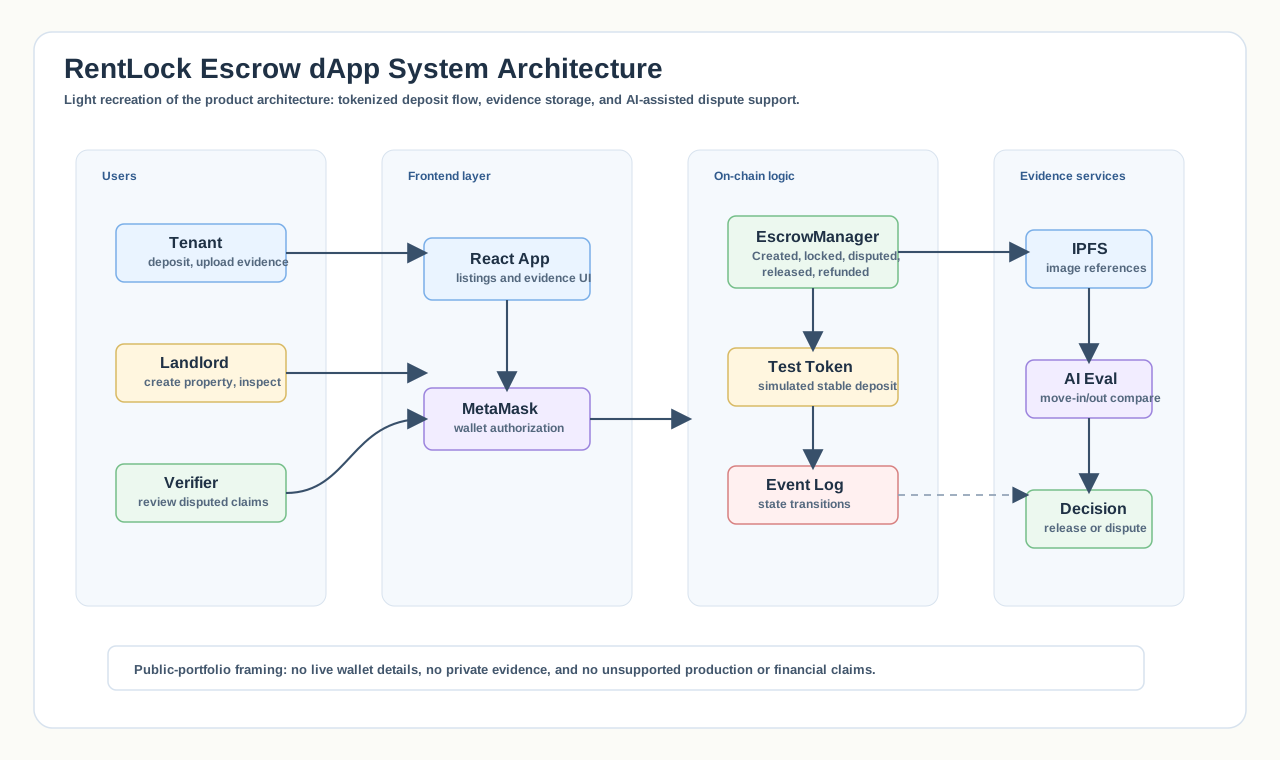
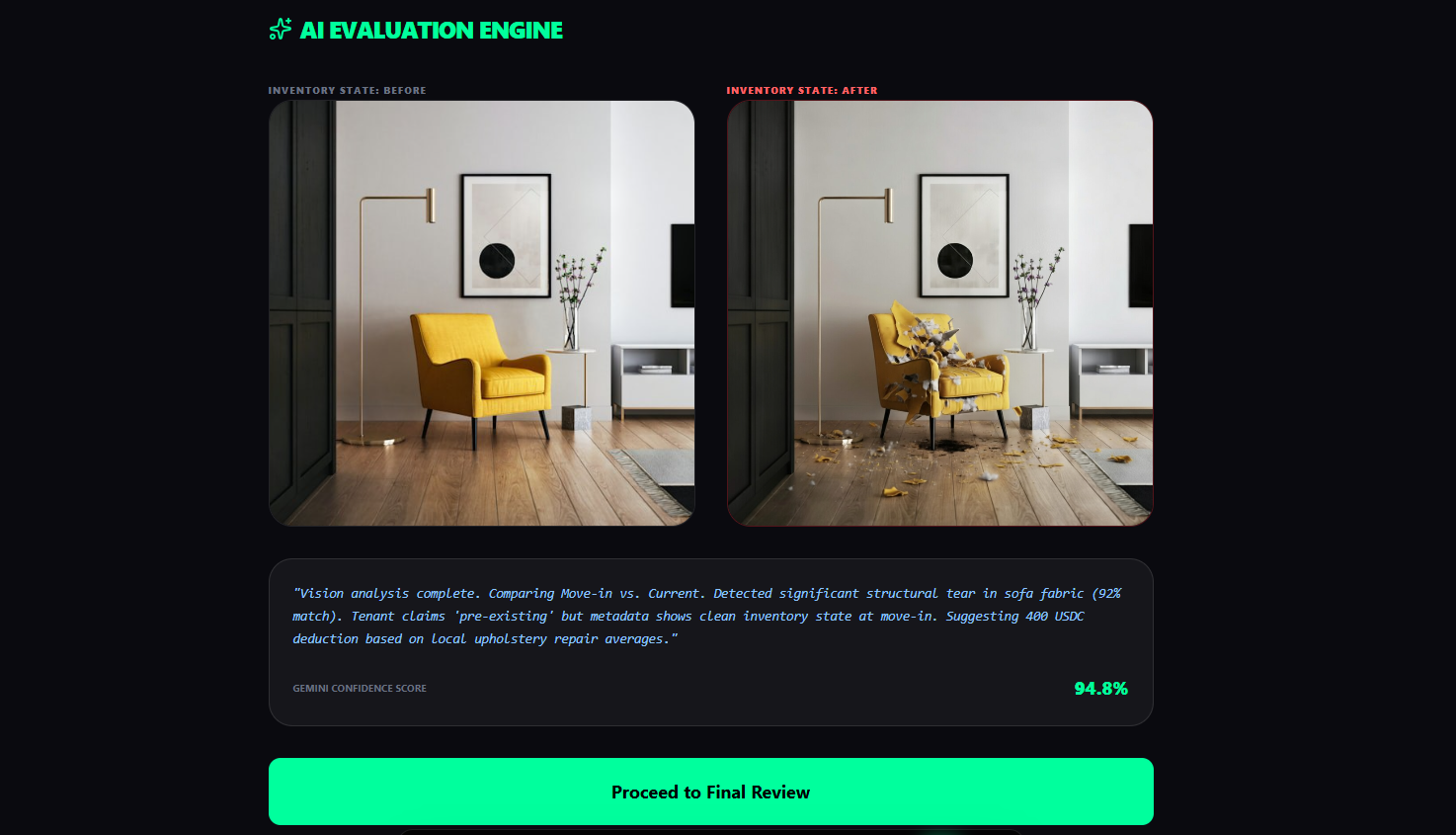
These selected visuals are more intuitive than a text-only writeup because they show the smart-contract workflow and product surface. The architecture is shown as a light-background recreation, and the AI-evaluation screenshot is cropped to remove the wallet/account header before publishing it.
System Design
1. Tokenized Deposit
The prototype uses a test token to simulate stable-value deposit handling. This allows contract logic to be tested without relying on real funds or exposing private wallet activity in the public writeup.
2. Escrow Manager Contract
The escrow contract manages lease creation, deposit funding, state transitions, refund requests, deductions, settlement, and dispute escalation. The contract state gives both parties a shared view of what actions are currently valid.
3. Role-Based Workflow
The product separates tenant, landlord, and verifier actions. Each role has a different interface and different permissions, which reduces accidental misuse and makes the workflow easier to explain.
4. Evidence Boundary
Evidence such as images or supporting documents should not be stored directly on-chain. A safer pattern is to store evidence off-chain and anchor hashes or references, with encryption and retention policies as future work.
5. Verifier Escalation
If the parties cannot settle, a verifier flow can review the dispute and trigger the appropriate outcome. This mechanism requires careful incentive design so reviewers are compensated without encouraging low-quality participation.
Implementation Lessons
- Single ABI source: Frontend-contract mismatches can break the application even when the smart contract itself compiles. Treat contract interfaces as shared artifacts.
- Events matter: Contract events help the frontend update state without relying only on manual refreshes.
- State design is UX design: Users need to understand which actions are valid in the current lease state and what happens next.
- Escrow needs policy: The contract can enforce rules, but the product still needs evidence standards, dispute timelines, and verifier accountability.
Technical Notes From Source Report
Decision Framework
The design challenge was to decide what belongs on-chain, what should stay off-chain, and where human or verifier judgment is required. The strongest version of the product uses blockchain for settlement integrity, not as a dumping ground for private evidence.
| Decision Area | Option Considered | Selected Approach | Reasoning |
|---|---|---|---|
| Deposit custody | Landlord-held off-chain deposit | Escrow contract with explicit release paths | Improves transparency and gives both parties the same settlement rules. |
| Evidence storage | Store photos or documents on-chain | Off-chain evidence with references or hashes | Avoids exposing sensitive tenancy data while preserving an audit trail. |
| Dispute resolution | Force bilateral agreement only | Escalation path with verifier review | Prevents deadlock when parties disagree about deductions or damage evidence. |
| Reputation | Public dispute history | Selective disclosure as future direction | Supports trust without publishing private settlement histories. |
Qualitative Product Priority Chart
Custody Transparency
Critical
Privacy Protection
Critical
Dispute Fairness
High
On-Chain Minimalism
High
Verifier Incentives
Open Risk
Risk and Abuse Considerations
False Claims
Dispute flows should discourage frivolous claims through deposits, review fees, or reputation mechanisms.
Evidence Privacy
Inspection photos and tenancy documents can expose private information, so storage design matters.
Contract Trust
Users need clear explanations of what the contract can and cannot guarantee before they commit.
Limitations
- The prototype should be treated as an academic dApp concept, not a legally ready rental platform.
- Real deployment would require legal review, identity checks, jurisdiction-specific tenancy rules, secure evidence storage, and audited smart contracts.
- The public report intentionally excludes wallet screenshots and private account details.
- Verifier incentives need deeper modelling before they can be considered reliable at scale.
Recommended Next Improvements
- Add a formal state-machine diagram to document every allowed transition and failure state.
- Introduce encrypted off-chain evidence storage with hash anchoring and deletion policies.
- Add automated contract tests for edge cases such as duplicate actions, missed deadlines, partial refunds, and dispute cancellation.
- Prototype a reviewer dashboard that shows evidence packets, deadlines, and final decision status.
Source Trail
The RentLock source report did not include a formal academic bibliography. For the portfolio, the safest presentation is therefore to include technical notes derived from the report and avoid inventing a research-paper citation list that was not actually in the submitted material.
Concepts referenced in the source report: escrow state design, ERC-20-style test tokens, verifier
escalation, IPFS-style evidence anchoring, browser image compression, and selective disclosure.
Public portfolio boundary: no wallet screenshots, private account identifiers, raw evidence photos,
or unredacted report pages are published.
Recruiter Signal
RentLock demonstrates smart-contract product thinking rather than narrow token experimentation. The project covers workflow modelling, escrow states, incentive design, frontend integration, and practical privacy boundaries for public communication.
Smart Contracts
ERC-20
Escrow Logic
Frontend Integration
Mechanism Design
Product Risk