Start with a direct path
A fixed workflow is a sensible default when the steps are known. An agent is useful when the system must choose its next step from observations and tools. Anthropic's agent design guide separates workflows with predetermined paths from agents that dynamically control tool use. This distinction is more useful than counting agents.
Start with one agent, a narrow tool set and a testable completion condition. Add routing when tasks require clearly different paths, parallel work when independent tasks can be reconciled, and manager-worker delegation when the manager can verify each handoff. Every added actor creates ownership, cost and failure questions.
Know what the tree contains
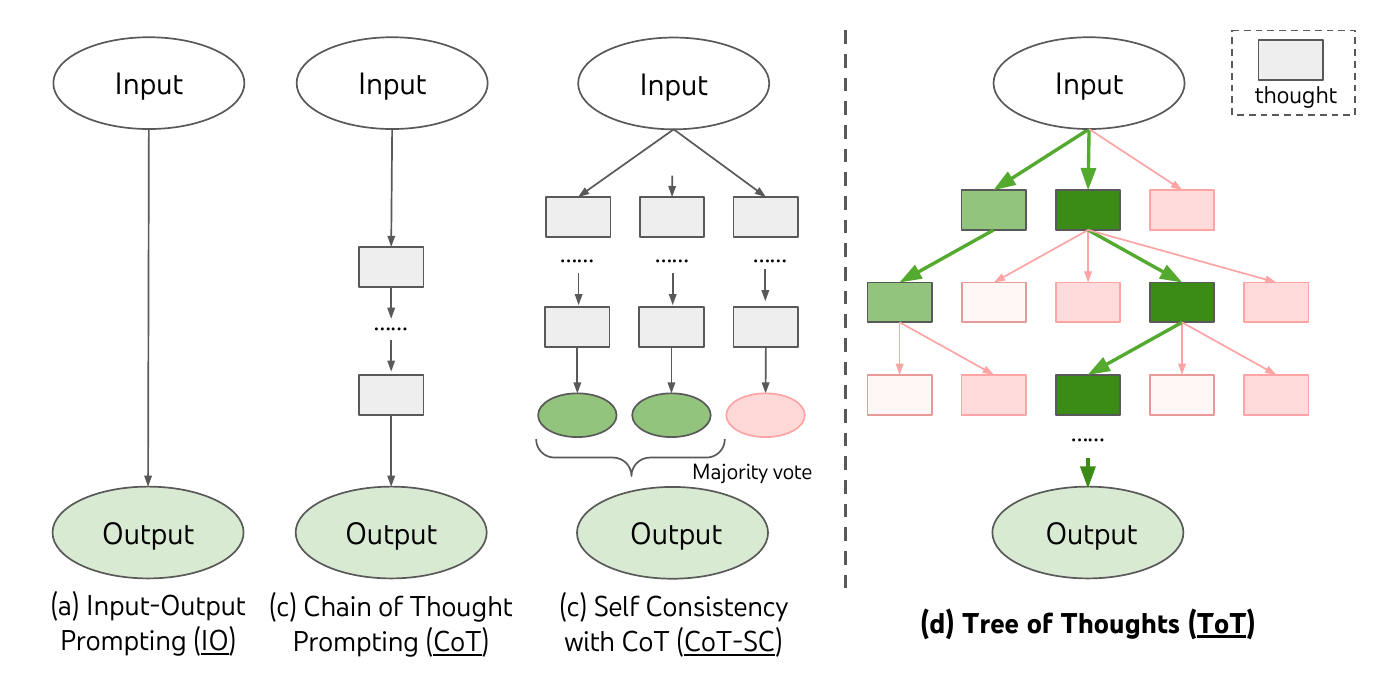
Best-of-N compares completed answers. Tree of Thoughts explores intermediate thoughts and can backtrack. Monte Carlo Tree Search (MCTS) builds an action tree: select, expand, simulate or estimate a return, then propagate the result. UCT balances branches with promising observed returns against those with little exploration.
- SelectFollow a promising path through the current tree.
- ExpandAdd a possible next state or action.
- SimulateEstimate an outcome with a rollout or evaluator.
- BackpropagateUpdate the visited branches with that result.
SYMPHONY uses heterogeneous language-model agents to propose and assess branches within an MCTS-style search. Its HotpotQA, WebShop and MBPP comparisons depend on the paper's selected model pools, feedback and budgets. SIFT changes the search object: it explores revised coding-agent harnesses, using pairwise judge rankings to choose candidates while task runs provide the real outcome evidence.
A coding agent has three possible fixes for a failing parser. First run a direct baseline and the relevant test. If each partial patch can be compiled and tested, bounded branching may help. If only the final user experience is observable, several independent complete attempts may be simpler than maintaining an action tree.
Give search a budget and a stop rule
Search scores depend on the evaluator. A rollout backed by a real test differs from one backed only by another model's opinion. Define the maximum attempts, token spend, time and escalation point before the loop starts. Record the selected branch and why it passed an independent final check.
Read the original work
These sources support the specific concepts above. Their task settings and publication status matter when applying a result.
- Building effective agentsRead for the workflow-versus-agent distinction and common orchestration patterns.
- Tree of ThoughtsRead for intermediate-state search on Game of 24, creative writing and crosswords.
- Bandit Based Monte-Carlo PlanningRead for the original UCT exploration rule; its assumptions matter when mapping it to LLM tasks.
- SYMPHONYRead for mixed-model planning and the reported benchmark conditions.
- Self Improvement via Fast Tree-searchRead for search over agent implementations, distinct from search within a single task.